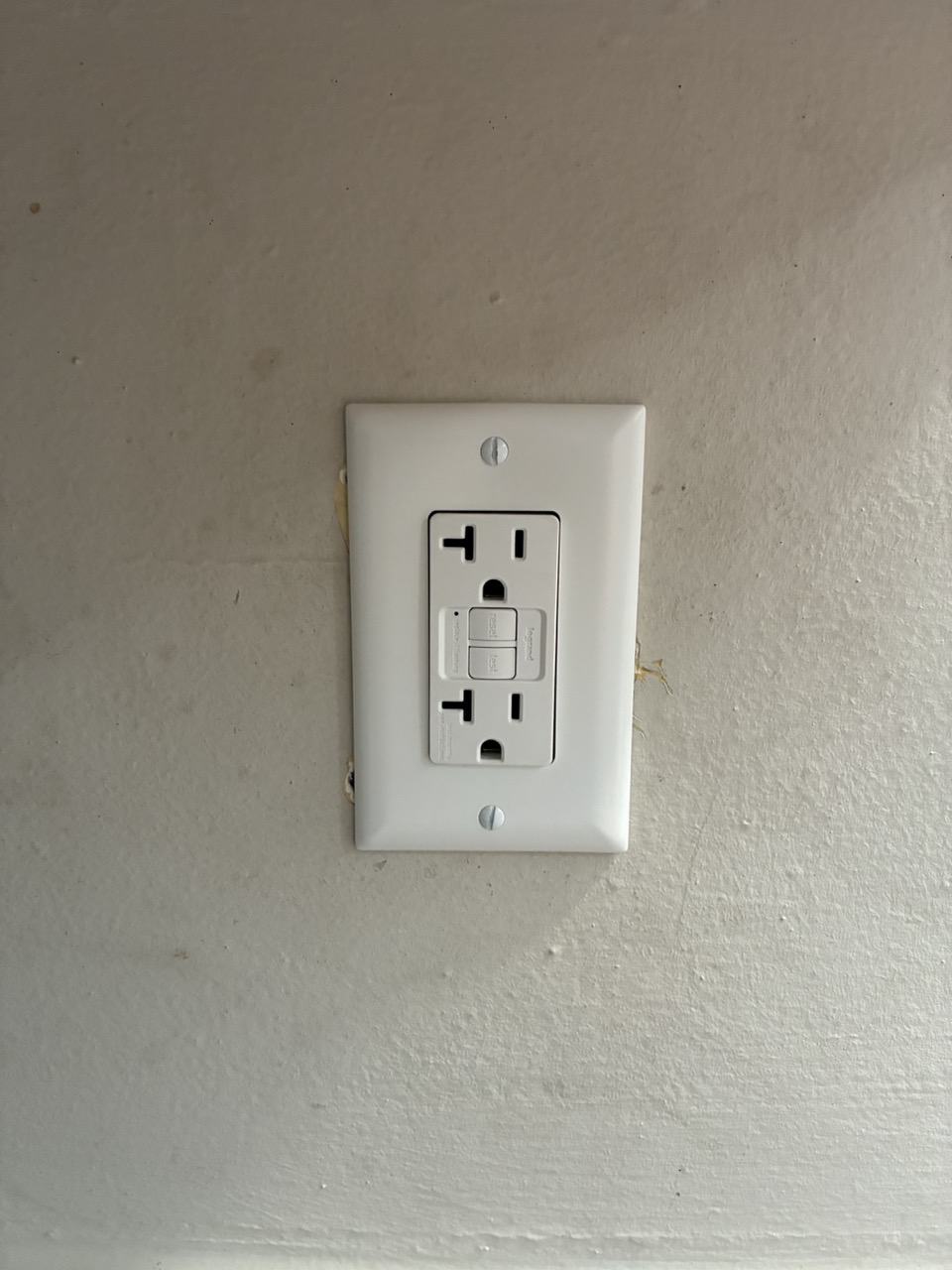
New outlet installation, dedicated circuits for appliances, GFCI/AFCI upgrades, and wiring for home additions and remodels.
Services
- New outlet installation (120V and 240V)
- Dedicated circuits for appliances, hot tubs, workshops
- GFCI outlets for kitchens, bathrooms, outdoor areas
- AFCI breaker upgrades
- USB outlet installation
- Wiring for home additions and remodels
- Appliance hookups (dryers, ranges, etc.)
- Outdoor and weatherproof outlet installation
What Does Outlet or Circuit Work Cost?
For residential service calls, our service charge is $150, and simple fixes, a dead outlet, a failed GFCI, a switch replacement, are quoted flat on the spot and usually repaired the same visit. New dedicated circuits and bigger jobs get a fixed quote up front after we see the run. Commercial service calls start at $500.
The honest truth about outlet calls: they range from us resetting a tripped GFCI (yes, sometimes that’s all it is, and we’ll tell you so) to finding burnt outlets that were a fire waiting to happen, outlets wired in reverse from past DIY work, and adding brand-new outlets to walls and areas that never had them. A recent example of how diagnosis works: a customer had outlets dead in the garage and upstairs, two areas that seem unrelated until you trace them. Each turned out to have its own GFCI, and both had been fried during a lightning storm. Replaced, tested, everything live again the same visit. Electrical problems usually aren’t where the symptom first shows up, which is why the diagnostic matters.
120V vs 240V - What's the Difference?
Most outlets in your home are 120V. But some appliances and equipment need 240V to operate. Here's the breakdown.
- 120V (standard outlets) - the regular outlets throughout your home. Used for lights, TVs, computers, small kitchen appliances, and most everyday devices. 15-amp or 20-amp circuits with standard NEMA 5-15R or 5-20R receptacles.
- 240V (high-power outlets) - delivers twice the voltage for high-draw equipment. Used for electric dryers, ranges/ovens, central AC, EV chargers, hot tubs, welders, and workshop equipment. These outlets look different - they have a different plug configuration for each amperage rating to prevent plugging something into the wrong outlet.
- Common 240V configurations:
- 30-amp (NEMA 14-30) - electric dryers
- 50-amp (NEMA 14-50) - electric ranges, EV chargers, RV hookups
- 50-amp (NEMA 6-50) - welders, some EV chargers
- 60-amp - hot tubs (typically hardwired, no outlet)
Every 240V installation requires a dedicated circuit from your panel. We size the wire, breaker, and outlet to match the specific equipment you're connecting.
NEC 2023 AFCI & GFCI Requirements
The National Electrical Code (NEC) 2023 has expanded where AFCI and GFCI protection are required. These aren't optional add-ons - they're code requirements for new circuits and certain renovation work.
GFCI Protection (Shock Prevention)
GFCI devices detect ground faults (current leaking to ground through water, a person, or a fault) and cut power in milliseconds. Required in:
- Kitchens - all countertop outlets and outlets within 6 feet of a sink
- Bathrooms - all outlets
- Garages and accessory buildings
- Outdoors - all outdoor outlets
- Crawl spaces and unfinished basements
- Laundry areas
- Boathouses and pool areas
- Any outlet within 6 feet of a sink (including wet bars, utility sinks)
AFCI Protection (Fire Prevention)
AFCI devices detect dangerous arcing (sparking from damaged wires, loose connections, or pinched cords) and shut off the circuit before it can start a fire. Required in:
- Bedrooms
- Living rooms and family rooms
- Dining rooms
- Hallways and foyers
- Closets
- Sunrooms and recreation rooms
- Laundry areas
- Kitchens (yes, both AFCI and GFCI are required in kitchens under NEC 2023)
In short, almost every room in the house now requires AFCI protection, and wet areas require GFCI. We install dual-function AFCI/GFCI breakers where both are required on the same circuit.
New Circuit vs Tapping an Existing Circuit
When you need a new outlet, the question is whether it can share an existing circuit or needs its own dedicated run from the panel.
When You Need a New Circuit
- The device requires a dedicated circuit by code (refrigerators, microwaves, dishwashers, garbage disposals, bathroom outlets, laundry, HVAC, EV chargers, hot tubs, ranges, dryers)
- The existing circuit is already at or near capacity
- Adding to the existing circuit would exceed the breaker rating
- The new outlet is for a 240V device
- The new outlet is far from any existing circuit, making a new home run more practical
Mini Split & HVAC Equipment Circuits
Installing a mini split, or having an HVAC contractor install one? We handle the electrical side: the dedicated circuit, outdoor disconnect, and hookup, sized and protected per code. HVAC contractors across Cincinnati and NKY use us for exactly this, your installer sets the equipment, we make it safe and legal to run.
When You Can Tap an Existing Circuit
- Adding a general-use outlet in a room that already has outlets on the same circuit
- The circuit has capacity for the additional load
- The new outlet is close to an existing outlet or junction box on the same circuit
- The device is a low-draw item (lamp, phone charger, clock)
We assess the existing circuit load before tapping in. Adding an outlet to an already loaded circuit just moves the problem.
How Do I Know If My Home Needs Rewiring?
Full or partial rewiring is a major project, but sometimes it's the only real fix. Here are the indicators that your wiring has reached the end of its safe service life.
- Knob-and-tube wiring - if your home still has active knob-and-tube, any renovation or modification to those circuits requires replacement with modern wiring. Insurance companies increasingly refuse to cover homes with active knob-and-tube.
- Cloth-insulated wiring - the cloth insulation used in homes from the 1920s through 1960s becomes brittle and cracks over time, exposing bare conductors. This is a fire hazard that won't improve with age.
- Aluminum branch circuit wiring - common in homes built between 1965 and 1973. The connections expand and contract with heating cycles, loosening over time. Proper remediation involves copper pigtails at every device with approved connectors.
- Frequent breaker trips across multiple circuits - if it's not just one circuit but several, the problem may be systemic rather than isolated.
- Burning smell or discoloration at outlets or switches - signs of overheating connections behind the wall.
- No grounding - two-prong outlets throughout the home mean the wiring has no equipment ground. Upgrading individual outlets to three-prong without actually running a ground wire doesn't solve the problem.
- Insurance or inspection requirements - some insurance companies and home inspectors require rewiring before they'll cover or approve the property.
Common Questions
Depends on whether an existing circuit can support it or if a new circuit needs to be run from the panel. Contact us for a project-specific estimate.
A dedicated circuit serves a single appliance or outlet, it doesn't share a breaker with anything else. Required by code for refrigerators, microwaves, dishwashers, HVAC equipment, and more.
GFCI (Ground Fault Circuit Interrupter) protects against electrical shock, required in wet locations like kitchens, bathrooms, and outdoors. AFCI (Arc Fault Circuit Interrupter) protects against fires caused by arcing, required in bedrooms, living rooms, and most living spaces per NEC 2023.
Yes. We run new wiring from existing circuits or add new circuits from the panel. The method depends on your home's construction and the load requirements.
Yes. Hot tubs typically require a dedicated 240V, 50-amp circuit with GFCI protection and a disconnect within sight of the unit. This is code-required.
Yes. Outdoor outlets require weatherproof covers and GFCI protection. We install them on decks, patios, garages, and exterior walls.
NEC doesn't set a maximum count for general-use circuits, but practical limits apply based on expected load. For 15A circuits, 8-10 outlets is a common guideline. For 20A circuits, 10-12.
Safety Questions
No. Power strips are temporary. Permanent reliance on power strips indicates you need more outlets or circuits. Overloaded power strips are a leading cause of electrical fires.
Warm outlets indicate a loose connection, overloaded circuit, or damaged wiring behind the outlet. Stop using the outlet and call an electrician, this is a fire hazard.
Two-prong outlets lack a ground connection. While not immediately dangerous, they provide no protection for your electronics and don't meet modern code. Upgrading to grounded three-prong outlets is recommended.